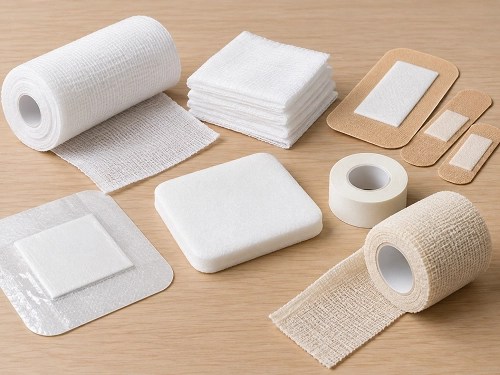
A wound dressing does more than cover a wound. It controls moisture, protects against contamination, manages exudate and keeps the surrounding skin intact. Which of these jobs matters most depends on the wound, and each dressing material does some of them better than others.
Why moist healing changed dressing design
Dry gauze was the default for decades. In 1962, George Winter showed in an animal model that superficial wounds kept under a moisture-retentive film re-epithelialised faster than wounds left to dry and form a scab. That finding is the basis of modern wound care. Most advanced dressings aim to keep the wound bed moist, but not so wet that the surrounding skin breaks down.
The aim, then, is to match the dressing to the amount of exudate, not to maximise either moisture or absorbency. A dressing that is too dry slows healing. One that is too wet causes maceration, a common and avoidable problem.
The main dressing materials compared
| Material | Exudate level | Typical use | Main limitation |
|---|---|---|---|
| Transparent PU film | None to very low | Cannula and catheter sites, superficial wounds, secondary cover | Cannot absorb fluid, so exudate pools beneath it |
| Foam | Low to high | Leg ulcers, pressure injuries, donor sites | Opaque, so the wound is harder to inspect |
| Hydrocolloid | Low to moderate | Minor burns, abrasions, shallow pressure injuries | Not for infected or heavily exuding wounds |
| Alginate | Moderate to high | Cavity wounds, bleeding wounds | Dries out and sticks if applied to a dry wound |
| Non-woven adhesive dressing | Low | Post-operative incisions, first aid, general protection | Limited absorbency, and not occlusive unless film-backed |
Summary based on general clinical guidance. Always follow local protocols and the product's instructions for use.
Material notes that affect real-world performance
Polyurethane (PU) film
PU film is thin, flexible and permeable to water vapour while blocking liquid water and bacteria. Moisture vapour transmission rate (MVTR) is the key property. If it is too low, moisture builds up under the film and the skin softens. If it is too high, the wound may dry out. Film suits low-exudate sites and is widely used to secure intravenous cannulae. The film is usually supplied as an adhesive-coated roll, which is why PU film adhesive rolls are a common starting point for dressing manufacturers.
Foam
Polyurethane foam absorbs vertically into its cell structure. This keeps exudate away from the wound edge and reduces maceration. Foam also cushions, which helps over bony prominences. Its strength is range: the same material family can be made in different thicknesses and densities for light to heavy drainage. See FULUO's foam wound dressing page, or the related guide Foam Wound Dressing: A Comprehensive Guide to Modern Wound Care.
Hydrocolloid
Hydrocolloid dressings combine gel-forming particles with an adhesive layer. They absorb fluid and form a moist gel at the wound surface. They stay in place for days, which suits shallow wounds that do not need frequent inspection. Because they are occlusive, they are not suitable where infection is suspected. FULUO has several explainers on this material, including Everything You Need to Know About Hydrocolloid Wound Dressing.
Alginate
Alginate fibres, derived from seaweed, absorb exudate and turn into a soft gel. Their ion-exchange behaviour with wound fluid also makes them useful for light bleeding. They need a secondary dressing, and they should not be used on dry wounds. For background, see FULUO's article Alginate Wound Dressings: Composition, Mechanisms, and Advances in Bioactive Healing Systems.
Non-woven adhesive dressings
Non-woven fabric is soft, breathable and conformable, and it is economical for high-volume use such as post-operative incisions and first aid. Its performance depends heavily on the adhesive coating and the pad. A good non-woven dressing stays attached through movement and removes without stripping skin. See Non-woven Wound Dressing and the raw material page Non-woven Adhesive Rolls.
Layers of a typical adhesive dressing
Many buyers compare finished dressings without looking at what is inside them. This simplified cross-section shows the layers where quality problems usually start.
Layers 1 and 3 are where adhesive coating precision matters. Uneven coat weight leads to patchy adhesion, edge lifting, or residue on removal. This is why coating and converting capability is as important to a dressing's performance as the choice of material.
A practical selection checklist
- Assess exudate first. None or minimal suggests film. Moderate suggests hydrocolloid or foam. Heavy suggests foam or alginate with a secondary cover.
- Check the periwound skin. Fragile or elderly skin needs a gentle adhesive and careful removal. Silicone-based or low-tack options are often considered here.
- Consider location and movement. Joints and sacral areas need conformable, shaped products.
- Decide how often the wound must be inspected. Transparent film allows visual checks. Opaque foam and hydrocolloid dressings usually do not.
- Reassess regularly. If the wound changes, the dressing should change. Signs of infection need clinical review, not just a different product.
What buyers and OEM brands should ask manufacturers
For distributors, hospital suppliers and brand owners, several technical questions separate reliable suppliers from the rest:
- Is coating done in-house? Control of adhesive coating, laminating, slitting and die cutting reduces variation between batches. FULUO reports about 4 million square metres of adhesive coating per year across a 20,000 m² factory.
- What testing is performed? Look for microbiological testing, environmental monitoring and physical and chemical performance testing. FULUO states it employs more than 10 full-time inspectors for this work. Skin-contact materials are generally assessed against biocompatibility standards such as the ISO 10993 series.
- Can the supplier customise? FULUO states it has developed more than 100 tape types as finished or semi-finished products for medical and sports customers. See OEM & Customization.
- Can they supply both raw rolls and finished goods? This matters if you want to start with materials and move to finished dressings later. Browse Medical Roll Materials and Wound Care Dressing.
- What compliance support is offered? Check certifications directly with the supplier. FULUO's System Certification section is the place to start, and you should request current certificates for your target market.